
VoyantServer (and the corresponding Docker version) has been updated with over six months of features and bug fixes since the last bundled update in July 2025.
The full release notes are available on GitHub, but the most significant changes are outlined below.
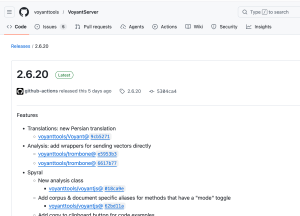
What’s new (at a glance)
- New Persian interface translation (translation credits include Mehdy Sedaghat Payam and Zahra Farhangfar).
- New visualization: Constellations — a network view of high-frequency terms connected by word-vector similarity.
- Spyral improvements: a new
Spyral.Analysisclass, clearer corpus-vs-document method aliases, and better inline docs (history navigation + copy button). - Categories upgrade: an option to directly edit category terms.
- Bug fixes, including a notable fix for TermsBerry image export.
Persian interface translation
Thanks to the hard work of Dr. Mehdy Sedaghat Payam (with translation credits also including Zahra Farhangfar),
the Voyant Tools interface now includes a Persian translation. This improves accessibility for Persian-speaking students and researchers,
and reflects Voyant’s broader commitment to multilingual DH infrastructure.
New visualization: Constellations
Voyant now includes a new visualization called Constellations, originally coded by Ryan Chartier and adapted for Voyant by
Andrew MacDonald. Constellations is a specialized network graph of high-frequency terms that are connected through similarity in vector space
(word vectors).
Practically, this offers a new way to see how prominent concepts cluster and relate across a corpus—especially useful when you want something more exploratory than a ranked list,
but more structured than a generic network graph.
Spyral upgrades: simpler workflows, more power
This release includes several improvements to Spyral that both simplify and expand its capabilities.
1) A new Spyral.Analysis class
A new Spyral.Analysis class facilitates sending vector data directly to Voyant’s dimension-reduction algorithms—the same family of methods that provides underlying data for
tools like ScatterPlot and the new Constellations visualization.
2) Clearer, explicit method names (Corpus vs. Document)
Spyral methods that could apply to either documents or corpora now have explicit versions, making notebooks easier to read, teach, and maintain:
corpusCorrelations,corpusMetadata,corpusPhrases,corpusTermsdocumentCorrelations,documentMetadata,documentPhrases,documentTerms
3) Inline documentation improvements
Spyral’s inline documentation has been improved with history navigation buttons and a copy-to-clipboard button for code examples.
Categories: faster editing and reuse
Voyant Tools’ Categories functionality now includes an option to directly edit category terms, supporting faster workflows and reducing the need to manually add terms one by one.
Fixes: TermsBerry export (and many others)
Of the many bug fixes included in this release, one of the most impactful is a fix to TermsBerry image export. Thanks to Steve Swettenham for help in identifying this issue.
Additional fixes touch a range of tools and infrastructure—everything from vector handling tolerance to usability and documentation improvements.
How to update
Below are two quick pathways—one for the standard VoyantServer download, and one for Docker-based deployments.
(As always, if you’re running an institutional mirror or have a customized deployment, update on a maintenance window and consider backing up any persistent data volumes first.)
Option A: Update a local VoyantServer install (JAR / ZIP download)
- Download the VoyantServer 2.6.20 asset (ZIP) from the release page.
- Unzip the archive.
- Ensure Java 11 is available on the machine.
- Run
VoyantServer.jar(double-click, or run from Terminal/Command Prompt). - Open the locals (localhost) URL that VoyantServer reports in your browser.
Option B: Update a Docker-based deployment
If you’re using the Voyant Docker setup (for example, via the Voyant Docker repository and its compose configuration), update by pulling the latest changes/images and recreating containers:
# In your Voyant Docker deployment directory
git pull

# If using Docker Compose v2:
docker compose pull
docker compose up -d --force-recreate

# If using legacy docker-compose:
docker-compose pull
docker-compose up -d --force-recreate
If your deployment uses persistent volumes for configuration or data, keep those volumes intact during recreation; recreate only the containers/images.