
Most Voyant users know that one of the strengths of Voyant has always been its openness. With just few clicks, anyone can quickly upload texts, create a corpus, and begin exploring patterns, themes, and relationships without needing to sign in or set up an account. That simplicity has made Voyant especially valuable for quick experiments, classroom activities, and first encounters with text analysis. But, as we now have thousands of people using this tool for sustained research, teaching, and collaborative projects, questions of storage and persistence become increasingly important. What happens when a corpus is no longer temporary? How can users return to their materials with confidence? And how can Voyant continue to remain open while also managing storage responsibly?
To resolve those concerns raised above, the Voyant Developers will begin on an update in the coming months. You might ask, what would change or what remains? They simply want to build on earlier storage clean-up efforts so as to create a better balance between temporary and long-term use. The goal is not to remove the anonymous, low-barrier experience that many users value. Rather, it is to extend Voyant’s infrastructure so that it can better support both quick exploration and more durable scholarly workflows.
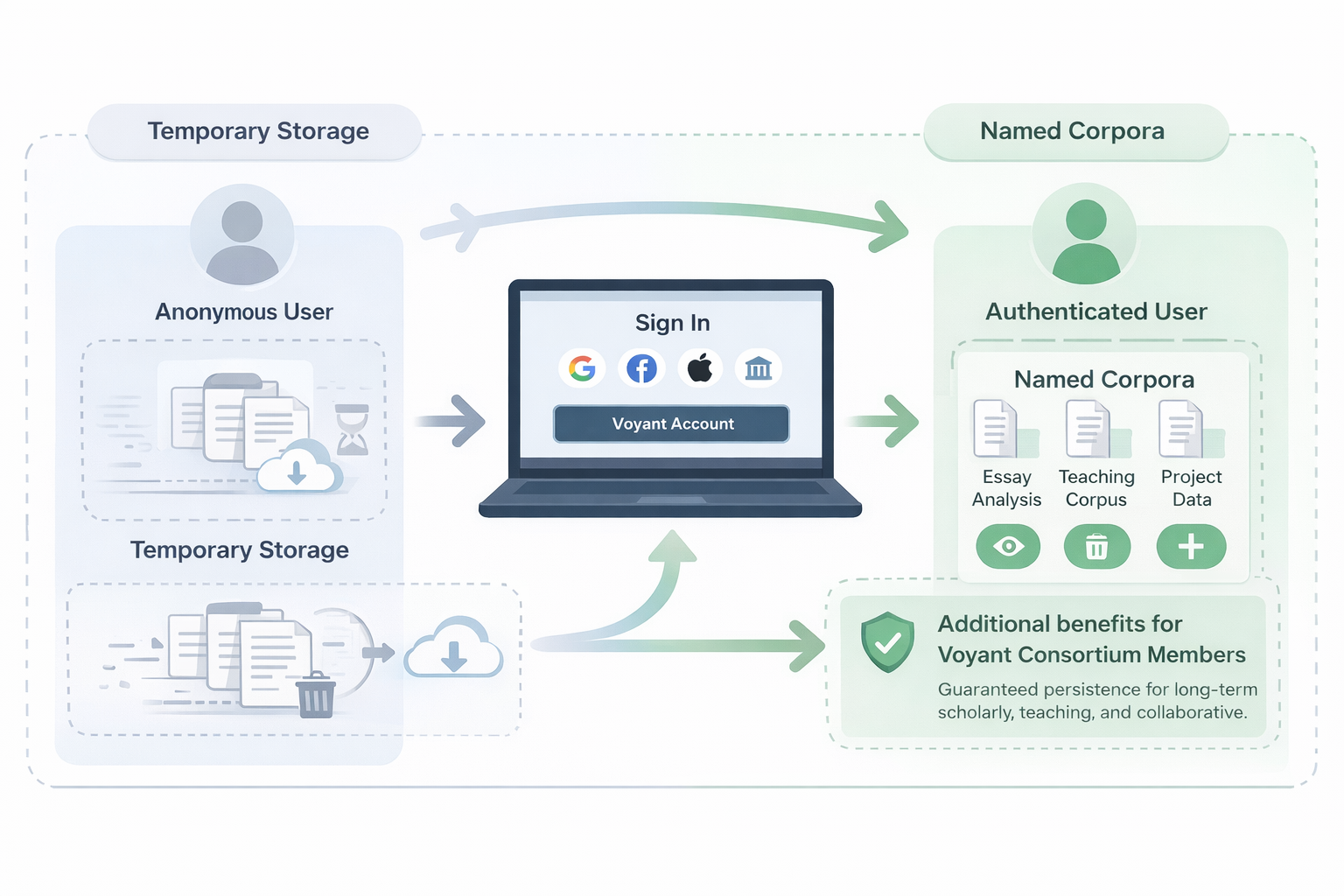 As you can see in the image above, Voyant is moving towards a model in which anonymous use will continue, while a new account-based system will open additional possibilities. Users will be able to authenticate through different identity providers and gain access to features such as creating named corpora, viewing all the corpora they have created, and deleting corpora they no longer need. In practical terms, this means more control over one’s research materials and a clearer sense of how those materials are stored and managed.
This development also introduces an important distinction between temporary storage and persistent access. For non-technical readers, the simplest way to think about it is this: Voyant will still support quick, anonymous corpus creation for immediate analysis, but users who need their work to remain accessible over time will have stronger tools for saving and managing it. The image helps make this transition visible: from a temporary, anonymous model to a more structured system of named corpora and authenticated access.
There is also a broader community dimension to this change. Users who link their account to their Voyant Consortium membership will be able to access additional guaranteed persistence features. This reflects an effort not only to improve functionality, but also to strengthen the long-term sustainability of the platform for researchers, teachers, and students who depend on it.
What makes this update especially significant is that it does not abandon the openness that has defined Voyant. Instead, it expands the platform’s capacity. Voyant is evolving to support different kinds of use at once: exploratory, pedagogical, collaborative, and long-term scholarly work. In that sense, persistence is not merely a technical issue. It is part of a larger conversation about how digital tools support research over time.
If you have suggestions, comments, or questions, please email
voyanttools@gmail.com.