
The International Symposium on Digital Humanities, hosted by Peter University in collaboration with the African Digital Humanities Lab, brought together scholars, researchers, teachers, and students for a rich two-day engagement with Digital Humanities in African contexts. Organised around the theme “Exploring Digital Tools for Interdisciplinary Research”, the symposium opened important conversations on computational text analysis, African Digital Humanities, research infrastructure, artificial intelligence, and core methods of digital interpretation.
The symposium was also notably well attended. Based on deduplicated webinar participation logs, 71 unique online participants joined the Day 1 sessions and 32 unique online participants joined Day 2. Across both days, the event recorded 89 unique online participants in total, with 14 participants attending both days. Those sessions were moderated by Dr.Augustine Farinola, Joseph Odo and Dr. Ozioma Okey-Kalu figures reflect online attendance and indicate a strong level of engagement with the programme, especially for an event dedicated to the growing field of Digital Humanities in African contexts.
One of the major highlights of the symposium was the contribution of Prof. Geoffrey Rockwell, whose sessions traced the longer history of computational text analysis from the concordance tradition to Voyant Tools, and later reflected on the infrastructure lessons of TAPoR. Together with presentations by Dr. Reggemore Marongedze, Yohanna Joseph Waliya, and Abel Ochika, the symposium demonstrated that Digital Humanities in Africa is not simply about adopting tools developed elsewhere. It is also about rethinking methods, language resources, research communities, and institutional futures in ways that are locally grounded and intellectually ambitious.
The event also drew attention to the importance of African Digital Humanities as a field of ownership, collaboration, and capacity building. Discussions across both days addressed low-resource languages, training, interdisciplinarity, ethics, device access, and the continued importance of critical human interpretation even in an era shaped by large language models and computational systems. Taken together, the symposium showed that Digital Humanities is not merely a technical supplement to the humanities, but a growing scholarly practice with the power to reshape research, teaching, and collaboration.
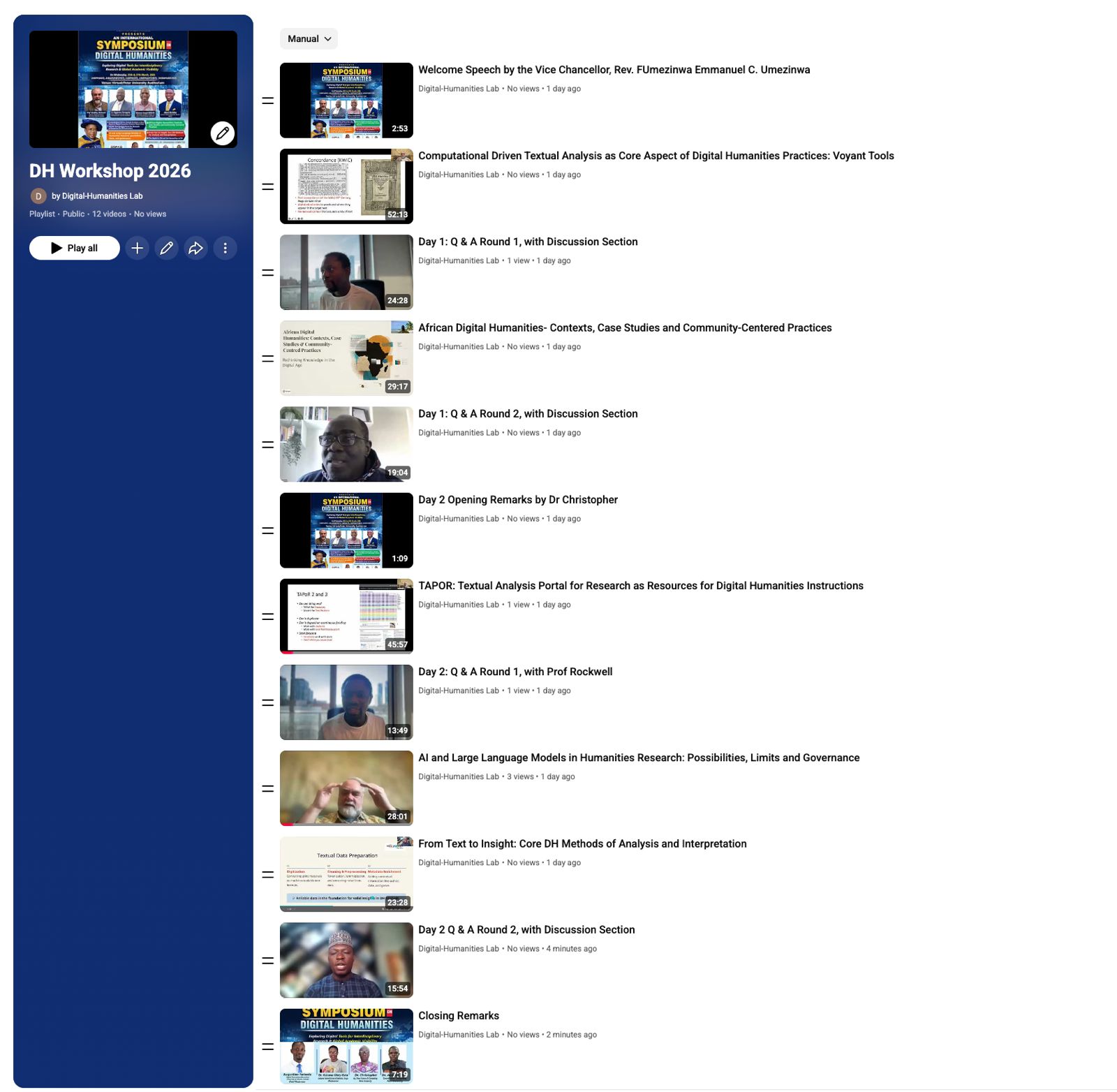
For those who could not attend live, or for participants who would like to revisit the sessions, the full video playlist is available below. Click the image to open the YouTube playlist in a new tab.
The symposium has also been documented in a full monograph, which brings together the event’s major lectures, discussions, reflections, speaker profiles, resources, and selected bibliography. Readers who would like a fuller account of the programme can download the PDF below.
Download the Symposium Monograph (PDF)
This symposium stands as an important contribution to the continuing development of Digital Humanities across African institutions. It created space not only for the discussion of tools such as Voyant, but also for reflection on the broader intellectual, linguistic, infrastructural, and ethical conditions that shape digital scholarship today. We are pleased to share this event with the wider Voyant Consortium community.